Author: admin

  • UALR Active Condition

    UALR Campus Living – Winter Weather Update

    Campus Living Advisory

    Winter Weather & Freeze Protection Update

    Status: ACTIVE
    đź’§ Drip Protocol: ACTIVE
    Prevent Frozen Pipes

    To prevent plumbing failure in your unit, please follow these instructions immediately:

    • Drip Faucets: Turn on the cold water faucet in your kitchen and bathroom. Allow it to drip steadily (a slow trickle).
    • Open Cabinets: Open all cabinet doors under sinks (kitchen and bath) to allow warm room air to reach the pipes.
    • Thermostat: Ensure your heat is set to at least 68°F and set to “Auto”. Do not turn off your heat.
    đźš— Road Conditions
    Check Before You Travel

    Campus roads and surrounding Little Rock highways may be hazardous.

    We utilize IDrive Arkansas for official road status. Please check the live map for ice, snow, and accident reports before leaving campus.

    External Link: Arkansas Department of Transportation

    Campus Living Assistance

    If you experience a heating failure, burst pipe, or water leak, contact staff immediately.

    Campus Living Office / Maintenance

    501-916-3743

    Staffed 24/7 during emergencies
    DPS (Public Safety)

    501-916-3400

    For life safety emergencies
  • Welcome to a New Semester at UA Little Rock

    Welcome Week: Start Strong

    Welcome Week at UA Little Rock is designed to help students transition smoothly into the semester by connecting them with campus resources, student organizations, and the Trojan community.

    Attending Welcome Week events is more than social engagement—it’s an opportunity to build routines, establish support networks, and set expectations for academic excellence from day one.

    Staying on Track Academically

    Plan with Intention

    Review each syllabus early and map out key deadlines. Proactive planning reduces stress and keeps coursework manageable.

    Manage Your Time

    Establish consistent study blocks each week. Treat academic time like a scheduled commitment.

    Engage Actively

    Participate in class discussions, form study groups, and ask questions early to reinforce learning.

    Use Campus Resources

    Faculty office hours, tutoring services, and academic advising are built-in tools for student success—use them.


    Success is built through consistency, balance, and preparation. Welcome Week is the first step—what you build afterward defines the semester.

    Welcome to UA Little Rock. Let’s make this semester count.

  • Little Rock Police Dispatch:

    Real-Time Monitor

    This dashboard provides a direct window into the City of Little Rock’s active police operations. It streams data directly from the Computer Aided Dispatch (CAD) system.


    Why is this data important?
    Safety
    Community Awareness: Identify active incidents or disturbances in your neighborhood in near real-time.
    Traffic
    Commute Planning: Spot “Accident” or “Traffic Stop” reports to avoid congested routes.
    Civic
    Transparency: See exactly how public safety resources are deployed across the city.
  • I Smell Something Funny Burning

    What to Do If Someone Is Burning Trash and the Smell Is Toxic

    Burning trash in residential areas is not only illegal in many cities, including Little Rock, but it can also release harmful toxins into the air. Here’s the proper procedure to protect yourself and your community.

    🚨 Step 1: Immediate Emergency Response

    • If the burning is active and poses a health hazard or fire risk, call 911 immediately.
    • Provide the exact location and describe the situation clearly.

    📞 Step 2: Report Non-Emergency Burning

    For ongoing or nuisance burning that isn’t an immediate danger:

    • Dial 311 to file a complaint with Little Rock Code Enforcement.
    • Contact the Fire Prevention & Community Outreach Division at Central Fire Station (624 S Chester St).

    🏛️ Step 3: Know the Law

    Little Rock ordinances prohibit trash burning in congested districts. Yard waste burning may be allowed under strict conditions, but it must not:

    • Create a persistent nuisance
    • Pose a fire hazard
    • Obscure visibility on roads

    đź“‹ Step 4: Escalate if Necessary

    If the issue continues:

    • Contact the Arkansas Department of Energy & Environment – Air Quality Division at (501) 683‑0873.
    • Report to the EPA or use the Arkansas DEQ online complaint system.
    Tip: Document the incident with photos or videos if safe to do so. This helps enforcement agencies take action faster.
  • Professional Laptop & iPad Repair – Licensed & Certified

    Looking for reliable tech repair? I specialize in laptop and iPad repair with years of hands-on experience. Whether it’s hardware issues, software troubleshooting, or performance optimization, I’ve got you covered.

    Licensed & Certified Technician
    CompTIA A+ Certified
    Fast, professional, and affordable service

    I take pride in delivering quality repairs and ensuring your devices run like new. Contact me today for quick turnaround and expert care!

  • Google’s Big Sleep AI Agent: A New Era of Cybersecurity

    Key Points

    • Big Sleep is an AI agent designed to identify and patch vulnerabilities before hackers exploit them.
    • It uses predictive algorithms and real-time threat modeling to secure systems proactively.
    • This approach reduces zero-day exploits and strengthens enterprise security posture.

    Answers to Questions

    1. What makes Big Sleep different from traditional security tools?
      Unlike reactive tools, Big Sleep anticipates threats and applies fixes autonomously.
    2. What industries benefit most?
      Finance, healthcare, and government sectors gain significant protection against advanced persistent threats.
    3. Are there ethical concerns?
      Yes—issues include transparency, accountability for automated decisions, and potential misuse if compromised.

    Ethical Frameworks

    • Utilitarianism: Maximizes overall security benefits by reducing harm from cyberattacks.
    • Deontological Ethics: Raises questions about duty to disclose AI-driven decisions to stakeholders.
    • Virtue Ethics: Encourages responsible innovation and trustworthiness in AI deployment.
  • The New Bluetooth Protocol: What’s Good About It?

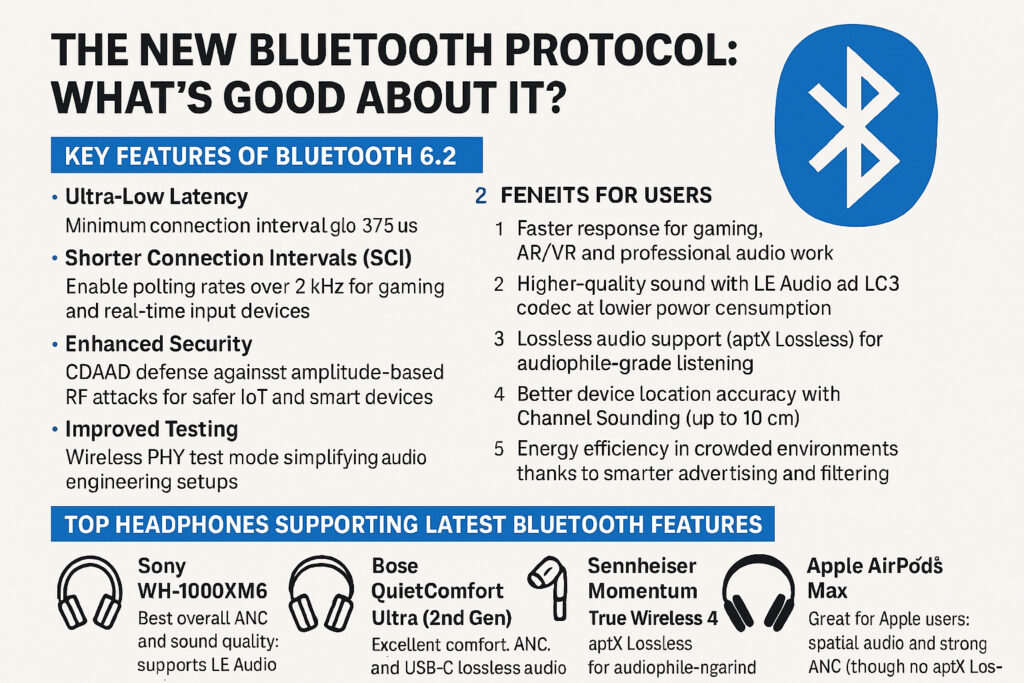
    Key Features of Bluetooth 6.2

    • Ultra-Low Latency: Minimum connection interval reduced to 375 µs, making wireless nearly as fast as wired.
    • Shorter Connection Intervals (SCI): Enables polling rates over 2 kHz for gaming and real-time input devices.
    • Enhanced Security: CDAAD defense against amplitude-based RF attacks for safer IoT and smart devices.
    • Better USB Integration: Easier LE Audio support for USB systems via Bulk Serialization Mode.
    • Improved Testing: Wireless PHY test mode simplifies audio engineering setups.

    Benefits for Users

    1. Faster response for gaming, AR/VR, and professional audio work.
    2. Higher-quality sound with LE Audio and LC3 codec at lower power consumption.
    3. Lossless audio support (aptX Lossless) for audiophile-grade listening.
    4. Better device location accuracy with Channel Sounding (up to 10 cm).
    5. Energy efficiency in crowded environments thanks to smarter advertising and filtering.

    Top Headphones Supporting Latest Bluetooth Features

    • Sony WH-1000XM6: Best overall ANC and sound quality; supports LE Audio and multipoint connectivity.
    • Bose QuietComfort Ultra (2nd Gen): Excellent comfort, ANC, and USB-C lossless audio support.
    • Sennheiser Momentum True Wireless 4: aptX Lossless support for audiophile-grade wireless sound.
    • Bowers & Wilkins Pi8: Premium earbuds with aptX Lossless and adaptive noise cancellation.
    • Apple AirPods Max: Great for Apple users; spatial audio and strong ANC (though no aptX Lossless).

    Why This Matters

    Bluetooth 6.2 is a game-changer for wireless technology. It combines ultra-low latency, improved security, and high-quality audio streaming, making it ideal for gamers, audiophiles, and anyone who values seamless connectivity.

  • Neuro Chips in Smartphones: The Future of On-Device AI

    Introduction

    What if your smartphone could think like a human brain? This is no longer science fiction neuro chips, also known as neuromorphic processors, are bringing brain-inspired computing to mobile devices. These chips promise faster, smarter, and more energy-efficient AI right in your pocket.

    What Are Neuro Chips?

    Neuro chips mimic the way neurons and synapses work in the human brain. Unlike traditional CPUs and GPUs, which process data sequentially, neuro chips use spiking neural networks (SNNs) and event-driven architectures. This means they only compute when necessary, saving power and enabling real-time learning.

    Why Do Smartphones Need Them?

    Modern smartphones handle complex AI tasks like:

    • Voice recognition
    • AR/VR rendering
    • Biometric security
    • Health monitoring

    Traditional processors struggle with these tasks without draining battery life. Neuro chips solve this by:

    • Reducing power consumption up to 10Ă—
    • Enabling privacy-preserving AI (data stays on-device)
    • Supporting always-on intelligence for contextual awareness

    How Do They Work?

    Neuro chips integrate sensing and computing in one unit. They process signals as spikes (similar to how neurons fire) making them highly efficient. Some designs even combine vision sensors with neuromorphic processors for ultra-low-power image recognition

    Applications in Smartphones

    • Real-Time Computer Vision: Object detection and facial recognition without lag
    • Voice Assistants: Faster, private speech processing
    • Gesture Control: Touchless navigation
    • Security: Advanced biometric authentication
    • Health Monitoring: Motion and vitals tracking using edge AI sensors

    Advantages

    • Energy Efficiency: Extends battery life significantly
    • Low Latency: Real-time decision-making for AR and vision
    • Privacy: On-device AI reduces cloud dependency
    • Compact Design: Fits into small form factors without overheating

    Limitations

    • Immature Tooling: Training spiking neural networks is still evolving
    • Accuracy Trade-offs: SNNs may lag behind traditional AI in raw accuracy
    • Cost and Complexity: Specialized hardware increases development cost
    • Limited Ecosystem: Fewer apps and frameworks compared to conventional AI chips

    Key Players

    • Intel (Loihi series)
    • IBM (TrueNorth)
    • BrainChip (Akida)
    • SynSense (Speck)
    • Qualcomm, Samsung, Huawei also investing heavily in neuromorphic NPUs

    The Future

    Neuro chips are set to redefine mobile AI. Imagine smartphones that learn and adapt like humans without draining your battery. As the technology matures, expect smarter, more private, and energy-efficient devices that bring AI closer to the edge.

    Are you ready for a phone that thinks like you do?

  • How Drones Are Transforming Our World

    Drones have evolved from hobby gadgets into powerful tools that are reshaping industries, improving efficiency, and opening new possibilities. From agriculture to filmmaking, these flying machines are changing the way we live and work.

    Current Applications

    • Agriculture: Farmers use drones for crop monitoring, irrigation planning, and even pesticide spraying to boost productivity.
    • Delivery Services: Companies like Amazon and Zipline are testing drones for package and medical supply delivery, reducing time and cost.
    • Media & Entertainment: Aerial photography and cinematography have become more accessible thanks to drones, revolutionizing creative industries.
    • Emergency Response: Drones assist in search and rescue missions, disaster relief, and delivering aid to hard-to-reach areas.

    Future Trends

    The future of drones looks promising with advancements in AI, automation, and connectivity. Here are some trends to watch:

    • AI-Powered Drones: Autonomous navigation and obstacle avoidance powered by machine learning.
    • Swarm Technology: Coordinated drone fleets for military, agriculture, and logistics applications.
    • Integration with IoT and 5G: Faster communication and real-time data sharing for smarter operations.

    Challenges and Ethics

    Despite their benefits, drones raise important ethical and regulatory questions:

    • Privacy Concerns: Unauthorized surveillance and data collection can infringe on personal rights.
    • Safety Regulations: FAA and global aviation authorities enforce strict rules to prevent accidents.
    • Responsible Usage: Balancing innovation with accountability is key to sustainable drone adoption.

    Top Consumer Drones in 2025

    1. DJI Mavic 3 Pro: Known for its exceptional camera quality and long flight time.
    2. Skydio X2: Advanced obstacle avoidance and autonomous flight capabilities.
    3. Autel EVO II: High-resolution imaging and robust performance for professionals.

    Conclusion

    Drones are no longer just futuristic gadgets—they are practical tools shaping industries and everyday life. As technology advances, their role will only grow, making it essential to address challenges and embrace opportunities responsibly.

  • Latest Microcontrollers & Quick Tutorial for Beginners


    Microcontroller board and schematic diagram

    Microcontroller board and schematic diagram

    Latest Microcontrollers Overview

    Microcontrollers (MCUs) are the tiny brains behind modern electronics, powering IoT devices, wearables, robotics, and industrial automation. In 2025, the focus is on performance, connectivity, and energy efficiency. Here are some of the most notable options:

    • ESP32-S3 (Espressif Systems)
      Features: Dual-core LX7, Wi-Fi 4, Bluetooth 5.0, AI acceleration, USB OTG
      Best for: IoT, smart home, AIoT projects
    • STM32H7 (STMicroelectronics)
      Features: ARM Cortex-M7 at 480 MHz, advanced analog features
      Best for: Industrial automation, motor control
    • RP2040 (Raspberry Pi Foundation)
      Features: Dual ARM Cortex-M0+, cost-effective, rich I/O
      Best for: Education, prototyping
    • nRF5340 (Nordic Semiconductor)
      Features: Dual Cortex-M33, Bluetooth 5.2, strong security
      Best for: Wearables, healthcare, IoT

    Key Trends in 2025:

    • Ultra-low power designs for wearables and sensors
    • Integrated wireless connectivity (Wi-Fi, BLE, Zigbee)
    • AI acceleration for edge computing
    • Enhanced security with hardware encryption and TrustZone

    Quick Microcontroller Tutorial for Beginners

    What is a Microcontroller?
    A microcontroller is a small computer on a single chip that runs one program repeatedly. It includes a CPU, memory, and I/O ports for sensors and actuators.

    Beginner-Friendly Options:

    • Arduino Uno (ATmega328P) – Great for learning and prototyping
    • Raspberry Pi Pico (RP2040) – Affordable and powerful
    • ESP32 – Ideal for IoT projects with Wi-Fi and Bluetooth

    Steps to Start:

    1. Choose a board (Arduino is easiest for beginners).
    2. Install the IDE (Arduino IDE or PlatformIO).
    3. Connect the board via USB.
    4. Write your first program – Example: Blink an LED
    
    void setup() {
      pinMode(13, OUTPUT);
    }
    void loop() {
      digitalWrite(13, HIGH);
      delay(1000);
      digitalWrite(13, LOW);
      delay(1000);
    }
    

    Next Steps:

    • Try sensors (temperature, light)
    • Explore IoT with ESP32
    • Learn debugging and troubleshooting basics

    Nexys FPGA Boards & VHDL Development


    Nexys A7 FPGA Development Board

    Nexys A7 FPGA Development Board

    FPGA boards like the Nexys series are essential for learning digital design and hardware description languages such as VHDL. Here’s what’s trending:

    Latest Nexys Boards

    • Nexys A7 (Artix-7 FPGA) – XC7A100T FPGA, DDR2 memory, Ethernet, USB, VGA, accelerometer, microphone, and 5 Pmod ports. Perfect for education and prototyping.
    • Nexys Video – XC7A200T FPGA, HDMI input/output, DisplayPort, audio codec, FMC connector. Ideal for multimedia and high-bandwidth projects.

    Why VHDL Still Matters

    • Widely used in aerospace, defense, and telecom for reliability.
    • Structured and strongly typed for complex designs.
    • Modern trends: AI-driven design automation, chiplet-based architectures, and security-first workflows.

    Beginner VHDL Tutorial (Nexys A7)

    Example: LED controlled by a switch.

    
    library IEEE;
    use IEEE.STD_LOGIC_1164.ALL;
    
    entity led_switch is
        Port ( sw : in STD_LOGIC;
               led : out STD_LOGIC);
    end led_switch;
    
    architecture Behavioral of led_switch is
    begin
        led <= sw;
    end Behavioral;
    

    Steps:

    1. Create a new Vivado project.
    2. Add VHDL source and constraints file.
    3. Synthesize, implement, and generate bitstream.
    4. Program the Nexys board using Vivado Hardware Manager.

    Recommended Tutorials:


    What Can You Build with Nexys FPGA and IoT Devices?

    The Nexys A7 FPGA board combined with IoT technology opens up endless possibilities for innovative projects. Here are some exciting applications you can create:

    • Drones: Implement flight control systems, sensor integration, and wireless communication for autonomous or remote-controlled drones.
    • Remote-Control Cars: Design motor control logic, integrate Bluetooth or Wi-Fi for wireless control, and add sensors for obstacle detection.
    • Smart Home Devices: Build IoT-enabled lighting systems, security cameras, and automation controllers using FPGA for real-time processing.
    • Robotics: Create robotic arms or mobile robots with precise motor control, sensor feedback, and AI acceleration for object recognition.
    • Industrial Automation: Develop conveyor belt controllers, machine vision systems, and real-time monitoring solutions.
    • Wearable Tech: Use FPGA for low-latency signal processing in health monitoring devices or fitness trackers.
    • IoT Gateways: Implement secure, high-speed data processing hubs for connecting multiple IoT sensors and devices.